September 22, 2026
Unified Commerce in SMEs: Seamlessly synchronise Click & Collect between branch, webshop and Sage Operations
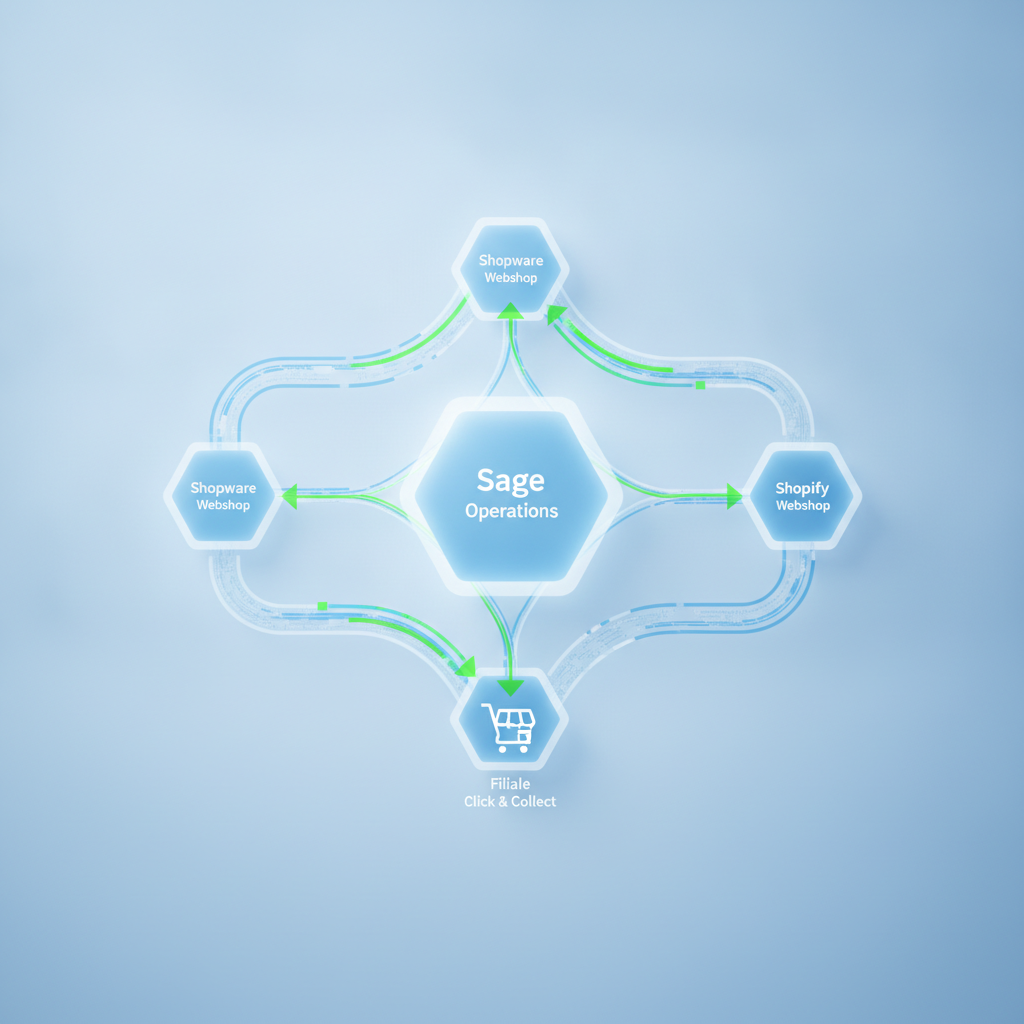
At 2:30 p.m., a customer places an item in their shopping cart via their smartphone, pays directly via PayPal, and selects the option „pickup in store.“ At 2:55 p.m., they enter your store to pick up the item. What sounds in theory like a smooth customer experience for many midsize businesses becomes a real test of process stress for many of them in practice. Does the staff at the checkout already know about the order? Is the item physically still in the shelf? Or was it carried by a walk-in customer ten minutes ago? The answers to these questions determine the success of Unified Commerce – and they are deeply rooted in the architecture of your ERP system.
Click & Collect, often referred to in the jargon as BOPIS (Buy Online, Pick Up In Store), is much more than just an additional shipping option in the checkout of Shopware or Shopify. It is the ultimate fusion of local retail stores and digital sales channels. This balancing act requires an IT infrastructure that does not think in time-delayed batch processing (batches), but in milliseconds. This is exactly where Sage Operations demonstrates its technological superiority as a cloud-native ERP system.
The ultimate test for omnichannel: When synchronization fails in practice
To understand the need for a cloud-native architecture, it is worth taking a look at the classic sources of error in traditional systems. Many businesses use ERP systems that are based on on-premises architectures and communicate with the online store using 15- or 30-minute data-based exports (such as CSV or XML).
For the aforementioned Click & Collect scenario, this means:
Phantom stocks: The online store displays an item as „available in store“ because the last inventory check was 20 minutes ago. In the meantime, the item was sold offline. The online buyer completes the purchase, the system receives the money – and the cancellation, including a disappointed customer, is pre-programmed.
Information gaps at the Point of Sale (POS): The customer is in the store, but the online order has not yet reached the ERP system. The store staff cannot find or record the order in the system.
Complicated follow-up procedures: If an online-purchased item is not to be accepted upon pickup and is left at the store, two isolated systems must be manually corrected (credit in the shop, re-stocking in the ERP).
Unified Commerce does not tolerate latency. The data exchange must be event-driven. As soon as an event occurs in System A, System B must react instantly.
Cloud-Native Architecture: The Engine for Real-Time Synchronization in Sage
Sage Operations was designed from the ground up for the cloud. This means not simply that old software is hosted on a foreign server. It means that the entire system is API-first (Application Programming Interface) designed. Every function, every change to the inventory and every order placement can be accessed by external systems via standardized web interfaces in real time.
In combination with modern e-commerce platforms such as Shopify or Shopware and a powerful middleware like maniacSeller.cloud, a highly performant ecosystem is created. Instead of waiting for the next cronjob, the systems work with so-called webhooks. A webhook is, simply put, an immediate digital call: The webshop notifies the middleware about the checkout, and this pushes the order through the API as a validated order in Sage in the same fraction of a second.
This latency-free data exchange is the indispensable foundation for digitally and flawlessly modeling the complex logistics processes of SMEs. For a deeper insight into the technical possibilities of data exchange, we recommend taking a look at our overview of the supported interface functions.
The ideal click & collect process in detail: From ordering to delivery
What does a seamlessly synchronized BOPIS process look like when Shopware or Shopify is optimally connected to Sage Operations? The workflow can be divided into four precise steps that run fully automatically thanks to the cloud-native infrastructure.
1. Granular inventory inquiry and reservation
Even on the product detail page in the webshop, the inventory must be displayed in a differentiated manner. It is not enough to display the cumulative total inventory (main warehouse + all stores). Sage manages multi-location inventories. Shopify (via „Locations“) and Shopware (via advanced inventory plugins or Rule Builder) can accurately display these locations.
As soon as the customer places the item in the shopping cart and starts the checkout process, a soft allocation can be performed in Sage Operations via the API connection. The item is temporarily blocked for a few minutes, so that a simultaneous offline buyer at the checkout counter cannot place an order for the item normally, if it is the last available item.
2. Immediate order processing and intelligent routing in the ERP
After successful payment (e.g. via Shopify Payments), the webshop fires up the webhook. The order is created in Sage. The crucial point here is the routing: The order must not end up in the regular pick list of the central shipping warehouse.
Based on the shipping method provided („pickup“) and the selected location (e.g., „Munich branch“), Sage Operations routes the order directly to the work inventory of the corresponding branch. The system assigns the sales to the correct cost center and labels the receipt so that no shipping labels are printed.
3rd Pick & Pack at the branch
The staff in the branch receives a real-time notification on the tablet or cash register system. The employee removes the product from the shelf, prepares it in the back room and processes the transaction in the system. This status change („Committed / Ready for pickup“) in Sage is immediately relayed back to the webshop via maniacSeller.cloud. The shop then automatically triggers the email to the customer: „Your order is ready for pickup.“
4. Transfer and seamless financial accounting
When the customer enters the store, they enter their order number. The goods are delivered. A final click in the system closes the order in Sage Operations. The inventory is finally booked, and the delivery note and invoice are generated securely for audit purposes. Since the payment has already been made online, the open item is immediately offset in Sage Financial Accounting with the payment notification from the payment service provider (e.g., PayPal). The store staff does not have to manually record payments – the cash drawer discrepancy at the end of the evening remains untouched.
Why Shopware and Shopify work perfectly with Sage
Both Shopware and Shopify have invested heavily in their omnichannel capabilities in recent years. They provide the necessary logical constructs needed by complex ERP systems like Sage Operations to operate efficiently.
Shopify Locations: Shopify natively allows you to set up different locations and assign inventory to these locations. This corresponds exactly to the multi-warehouse logic of Sage. Orders can be assigned directly to a specific Shopify location, which greatly simplifies the transfer of pick orders back to the ERP.
Shopware Rule Builder: In Shopware 6, highly complex business rules can be defined. For example, you can specify that Click & Collect is only offered for items that are not in the „warehouse/dropshipping“ status in Sage Operations, as they will never physically be stored in the store.
The task of an intelligent integration platform is to translate these specific shop logics precisely into the language of the Sage API, without you having to program as a retailer.
Scalability for the SME sector: More branches, more transactions
An often underestimated aspect of linking physical and digital commerce is the system load. Imagine a local event or Black Friday. The frequency in the stores increases rapidly, while online store traffic simultaneously rises sharply. Classic on-premise servers quickly reach their limits with thousands of API calls per hour. Databases block (deadlocks), and webshops experience timeouts.
The cloud-native architecture of Sage Operations is predestined for these scenarios. It dynamically scales the required computing resources. When hundreds of Click & Collect orders arrive simultaneously and thousands of cash register transactions flow from the stores into the central financial accounting system at the same time, Sage handles this load with composure. The latency remains consistently low, and the customer experience remains unaffected. To evaluate how this scalability translates to economic value for your individual transaction volume, an analysis of Transparent pricing and scaling models that grow with your business success.
Conclusion: Unified Commerce requires an uncompromising data foundation
The seamless integration of Click & Collect between the webshop, the branch and the ERP system is no longer just a „nice-to-have“; it is a fundamental expectation of modern consumers. When customers receive different information offline than online, their trust in your brand suffers massively.
Unified Commerce cannot be realized solely through a pretty frontend in Shopware or Shopify. It is primarily a discipline of the back-end. Sage Operations provides, through its cloud-native, API-centric architecture, exactly the data foundation that the SME needs to synchronize local store operations and digital sales without latency. By managing inventory, orders, and finances across all channels in real time, you not only reduce manual error rates and process costs but create excellent, cross-channel shopping experiences.
Find out everything about the Sage Operations shop and shipping interface maniacSeller.cloud here: www.maniacseller.cloud
Do you have any questions or would you like personalised advice?
Book a free consultation appointment here right now